In recent years, data privacy regulations and changes in user behavior have made it more challenging for online retailers to gather and utilize customer data. The rise of online anonymity has made it more difficult for online retailers to collect, analyze, and personalize shopper data, and has presented new challenges for ecommerce businesses. In this article, we explore the different layers of anonymous visitors and provide insights into how retailers can adjust their ecommerce sites.
Understanding the Three Layers of Anonymous Visitors
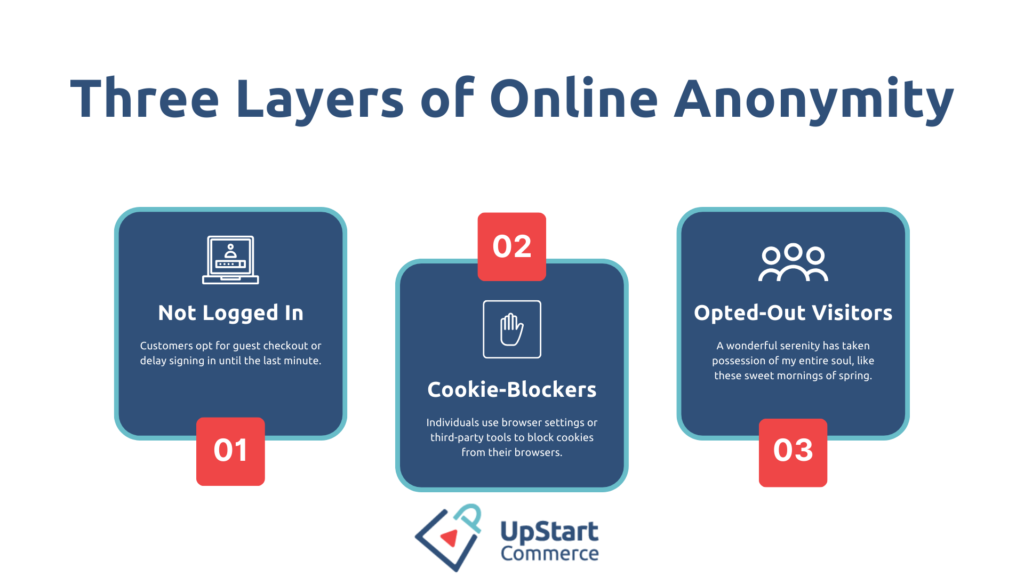
To effectively address the challenges of online anonymity, retailers must first understand the different layers of anonymous visitors. These include:
Users Not Logged In
This layer of online anonymity refers to shoppers who choose to use guest checkout options or delay their sign-in until the last moment. These individuals do not provide any identifying information, making it difficult for retailers to personalize their experience or track their behavior.
Cookie-Blockers
Cookie-blockers are individuals who use browser settings or third-party tools to block cookies from their browsers. Retailers use cookies to track user behavior and personalize their shopping experience. However, cookie-blockers prevent retailers from gathering this data, making it challenging to personalize their experience.
Anonymous Visitors Opt-Out
This layer of online anonymity includes individuals who have opted out of all tracks. These individuals do not allow retailers to track their behavior, rendering them a complete black box. Opted-out visitors comprise a significant portion of website visitors, making it essential for retailers to address this layer of anonymity.
Challenges of Anonymous Visitors
As online shopping continues to grow, so does the importance of data privacy. Changes in user behavior and data privacy regulations have made it challenging for online retailers to gather and utilize customer data. Online anonymity is one of the biggest challenges retailers face in collecting data from their customers.
Unfortunately, most online retailers have yet to come to terms with the current state of online anonymity and continue to rely on their existing suite of analytics and personalization tools. These tools are often ineffective when dealing with anonymous and cookie-less visitors, resulting in a generic shopping experience with no attempt made to personalize.
Without the ability to track individual browsing behavior and preferences, retailers are unable to make targeted recommendations or offer personalized experiences. This is a significant disadvantage as it reduces the effectiveness of marketing efforts and can lead to a decrease in customer satisfaction and loyalty.
Read more: 4 Pain Points Ecommerce Retailers Face
Standing Out with Session-Based Personalization
Online retailers can use session-based personalization to create a personalized shopping experience for anonymous and cookie-less visitors. Session-based personalization involves utilizing data that is available during the user’s browsing session.
Geolocation
Geolocation refers to determining the user’s location using their IP address or GPS data. Retailers can use this information to personalize the shopping experience based on the user’s location. For example, they can show promotions or product recommendations that are specific to the user’s country or region.
Device Being Used
Retailers can also use the device being used to personalize the shopping experience. For example, if a user is browsing on a mobile device, the retailer can show products that are optimized for mobile viewing and provide a mobile-friendly shopping experience.
In-Session Browsing Activity
By analyzing a user’s browsing behavior during their current session, retailers can personalize the shopping experience based on their interests and preferences. For example, if a user has been browsing for a specific product, the retailer can show related products in targeted promotions.
Read more: Preparing for Ecommerce Website Trends in 2023
Using AI to Gain a New Understanding of Anonymous Visitors
To gain a deeper understanding of anonymous shoppers and create a more personalized experience, retailers can leverage machine learning and predictive analytics technologies.
Classifying Shoppers into Segments
Through the use of machine learning algorithms, retailers can classify shoppers into segments based on non-PII data points such as browser extensions, network speed, and the number of open tabs. This enables retailers to gain insights into customer behavior and preferences and optimize their shopping experience accordingly. By classifying users into segments, retailers can personalize the shopping experience based on the user’s behavior.
Offering Highly Optimized Experiences
Retailers can utilize AI-based recommendations to optimize the experience of anonymous shoppers while respecting their privacy. This enables them to offer highly effective and personalized experiences to visitors. These recommendations can be based on the user’s browsing behavior, historical data, and other factors.
Navigating Online Anonymity in Ecommerce
The rise of anonymous visitors poses significant challenges for ecommerce businesses. Here are some of the key problems and potential solutions:
Difficulty in gathering and analyzing customer data
With anonymous visitors, ecommerce businesses cannot rely on traditional methods of data collection, such as cookies or user accounts. One solution is to leverage session-based personalization. This uses non-PII data such as geolocation and device type to tailor the shopping experience.
Without access to customer data, ecommerce businesses may struggle to offer personalized product recommendations or targeted promotions. One solution is to use AI and predictive analytics technologies to classify shoppers into segments based on session-based data. This allows for more effective personalization.
Privacy concerns
With data privacy regulations becoming increasingly strict, ecommerce businesses need to be mindful of how they collect and use customer data. One solution is to be transparent about data collection and give customers control over their data. This can be done through opt-in or opt-out mechanisms.
Inability to measure the effectiveness of marketing campaigns
Without access to customer data, ecommerce businesses may struggle to measure the ROI of their marketing campaigns. One solution is to use alternative metrics, such as engagement rates or click-through rates, to evaluate campaign effectiveness. There are also unique strategies retailers can use to engage anonymous visitors. These strategies rely on a variety of unified channels, timing, personalization, and leaning into their brand voice.
Conclusion
Online anonymity presents new challenges for retailers, but it also presents new opportunities for personalization and optimization. By adopting new technologies and leveraging AI, retailers can provide effective and personalized shopping experiences for anonymous shoppers, increasing customer loyalty and sales. It’s time for online retailers to adapt to the new reality of online anonymity and thrive in the ever-evolving ecommerce landscape.