Back in 2008, Netflix faced a major setback when its databases went corrupt for three days. They failed to deliver DVDs to stakeholders on time creating huge losses. To ensure this situation never happened again, Netflix decided to switch to a horizontally scalable distribution system. Employing Amazon Web Services (AWS) and following the cloud-native approach, they shifted their whole system to the cloud and closed down all of their data centers by 2016.
Today, every organization is following Netflix’s lead and moving to the cloud. Flexera concluded in a survey that 92% of organizations have already changed to a multi-cloud strategy. Cloud-Native has become a popular but usually confusing term. In the tech industry, there are multiple definitions of cloud-native SaaS. Here is how we define it:
Cloud-Native
In simple words, cloud-native is the development process of software applications that uses the scale, resiliency, and flexibility of the cloud.
“Cloud native technologies empower organizations to build and run scalable applications in modern, dynamic environments such as public, private, and hybrid clouds. Containers, service meshes, microservices, immutable infrastructure, and declarative APIs exemplify this approach.”
Why the Shift to Cloud-Native is the Right Thing To Do?
Cloud-Native development allows applications to build, run, and scale in public, private, and hybrid clouds. Features of MACH architecture; Microservices, API first approach, and headless architecture utilize the benefits offered by this form of development.
A report by Tigera concluded that 75% of organizations are switching to the cloud-native approach because it provides agility and speed. Gartner estimates that by 2025, 95% of digital applications will deploy following cloud-native development.
Software as a Service
The process of sharing or delivering applications over the Internet via a subscription license is called software as a service (SaaS). Software is hosted and is available to users through a browser. Clients do not have to install or maintain the software or hardware end of the application.
Research by Deloitte stated that 94% of professionals in 786 organizations use SaaS in their daily tasks. This shows the popularity of SaaS.
Cloud-Native SaaS
Software application services that are developed, updated, and scaled in the cloud are known as Cloud-native SaaS. They are made of multiple components that are independent of each other. Loosely coupling the components provides maximum speed, scalability, and flexibility to the users and developers. Users can license the application via a subscription model.
The Four Pillars of Cloud-Native
Cloud-Native heavily relies on the following 4 pillars:
| Microservices | Containers | DevOps | Cloud Infrastructure |
| Each feature of the application is an independent service belonging to different development teams. These teams develop, test, and deploy their features as per requirements without dependency on others. | Features are placed in independent containers to make the process of creation and deletion straightforward. | DevOps allows development to complete rapidly and provides updates whenever necessary without hindering other components. | This includes all the hardware and software components such as servers, services, networks, and API command lines to support cloud computing. |
High-level Diagram of Cloud-Native SaaS Architecture
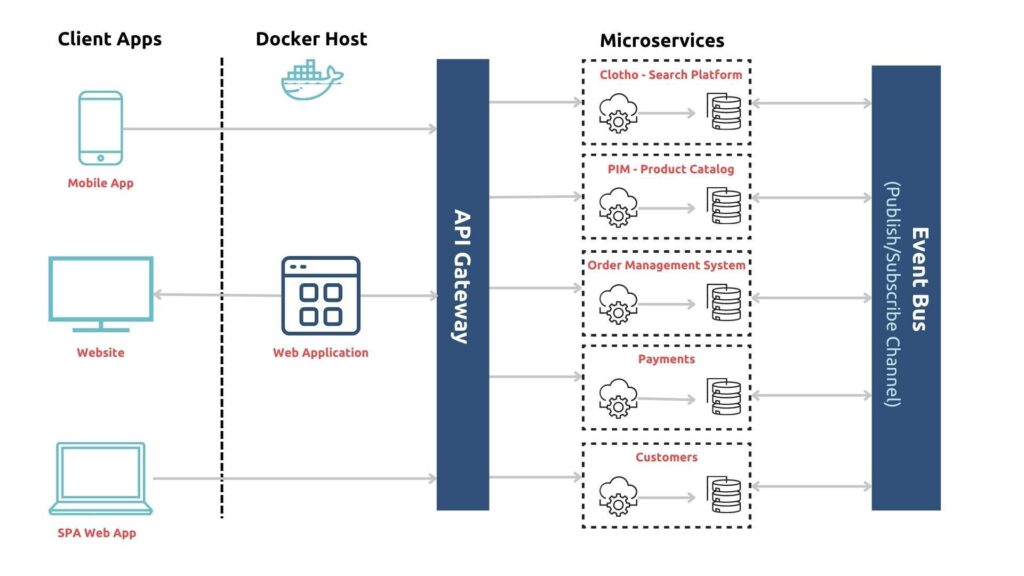 This diagram shows the basics of a Cloud-Native SaaS architecture which consists of client apps that call the functionality of microservices through the API gateways.
The Big 3 Cloud Service Providers
Identifying the need of organizations to switch to cloud companies like Amazon, Google, Microsoft, and many more provides cloud computing infrastructure as a service.
1. Amazon Web Services
Pioneering cloud services, AWS stepped into the world of the cloud in 2008. They have never looked back since. AWS continues to branch out and launch new services every passing day. From a call center engine to an AI and machine learning platform, AWS offers it all on the cloud. As of 2021, AWS has a revenue run rate of $40 billion.
2. Google Cloud
Despite not being as huge as AWS, Google Cloud is giving healthy competition to all the cloud services in the industry. With its partnerships with Salesforce, SAP, and Informatica, Google is quickly gaining popularity and becoming an industry favorite. As of 2021, Google Cloud has a revenue run rate of $11 billion.
3. Microsoft Azure
Azure is known for its AI and machine learning platforms. Struggling to become the number one in the cloud industry, Azure is working on integrating stacks to target both the hybrid and private cloud. Teams, Office 360, and Dynamics are some of the major cloud services provided by Azure that are industry favorites for regular use.
Why Switch to Cloud-Native SaaS?
There are numerous benefits of using Cloud-Native SaaS development. Here are 5 key benefits:
Scalability
One of the advantages of Cloud-Native SaaS is that there are no hardware limits for data storage. Applications are developed and expanded continuously without the usual issues. Therefore, costs to maintain software and hardware reduce as well.
User Experience
Customers have a seamless and smooth experience with cloud-native software. There are no disruptions or downtimes. Moreover, users can utilize the platform at any point and from anywhere in the world.
Easy to Troubleshoot
In case of an issue, it is easier to identify the errors. It allows the developers to fix bugs immediately and without any delays.
Agility
Cloud-Native applications are agile. The applications store the required data and functionalities within the cloud. They do not have a dependency on any other application. It makes the data retrieval and overall performance of the application better.
Security
Most people assume that cloud-native software is unsafe because it is decentralized, and each component communicates with one another. But that cannot be farther from the truth. Multiple layers of security such as two-factor authentication and restricted access are implemented in every component of the cloud-native architecture.
Major Players Using Cloud-Native SaaS
More and more organizations are shifting toward a cloud-native architecture for their applications. Following are some of the most famous ones:
Huawei
Huawei is known for its hundreds of different software and hardware applications worldwide. Despite their 8 data centers, they were running out of storage space, and the ability to manage multiple platforms was becoming increasingly difficult. Identifying this issue in 2016, Huawei switched to a Cloud-Native SaaS approach. Today, their IT department maintains thousands of containers and has around 4,000 nodes. Their costs are reduced by 30%, but the efficiency has increased tenfold.
Pinterest
There are perhaps billions of images and videos on Pinterest. This would require immense data centers to maintain all the records. To simplify matters and create a seamless experience for users, Pinterest switched to hundreds of layers of headless components, all loosely coupled with one another. The development team at Pinterest reduced inefficiency and build-time by 80%.
DISH Company
The DISH Network is a large organization that commands the technology, entertainment, and telecommunications world. By switching to the cloud-native application approach, they can implement an iterative and agile method in their businesses. Cloud-native architecture has reduced their downtimes and sped up their release times.
T-Mobile
Within five years of utilizing the services of VMware cloud, T-mobile has doubled its customer base. Due to the cloud-native approach, they are able to innovate, implement, and adapt quickly in the fast-paced technology environment. Furthermore, their costs have reduced dramatically because only a handful of people manage platforms that were managed by hundreds before shifting to the cloud.
Cloud-native SaaS services require a lot of teamwork and effort. Efforts begin with designing the architecture and continue through every software deliverable while keeping the customer’s needs in mind. Data-centric organizations must incorporate cloud-native approaches to reduce their data center footprints and utilize the pool of information and applications available on the cloud.
At UpStart Commerce, our goal is to make the life of our customers as easy as possible. This is why we provide architectures that are cloud-native and easy to use. Following a headless, composable, and API-driven approach are the basic tenets of our team. To understand what we do, look at the services we offer.